
Emily Ash Powell is a writer and brand consultant from South Wales who lives in north London and misses the sea. She is the author of the newsletter Hurdling, which looks at how we get over the things that get in our way.
1. Where do you rest your head?
On the border of Islington and Hackney in De Beauvoir, north London.
In my decade of living in London, I've lived in all sorts of places – Tooting Bec, Wandsworth Common, Battersea, Kingston, Acton – but this is the first place I've felt I could call home instead of Wales. My husband and I moved here just over two years ago (two weeks after our wedding – what on earth were we thinking?) and we love it. Hands down, this is my favourite place I've ever lived in London. I'm so annoyed I wasted so much time living elsewhere. I wish I could go back in time, move here immediately and spend 10 years soaking every last drop out of this corner of London.
These days, it takes a lot to get me to leave my borough. If I can't cycle there in 30 minutes, there needs to be a really, really good incentive.
2. What's something amazing about your area that only the locals know about?
There's a real sense of community here in De Beauvoir, which you can feel every day on the local neighbourhood WhatsApp group. So when I saw this question, I dropped it into the chat to see what some of the longer-term residents would say.
I had loads of responses about various restaurants, organisations and annual events, but my favourite anecdote was from a local lady named Ginette, who told me that the milkman who covers the De Beauvoir milk round is a man called Barry Hudson, who's been delivering milk since March 1981. In the 34 years that she and her family have lived in the area, Barry has continued to deliver her milk, watching her sons grow up from babies to adults on the doorstep.
Given that last year only 3% of UK milk was delivered to the door, compared to 99% in 1970, this feels like such a sparkly gem to me. As someone who grew up in South Wales, where everyone knows everyone and your neighbours are 'aunties', I'm always beside myself when I encounter something that feels close to that community feeling.
I think a lot of people who don't live in London assume that every corner of the city is all new, new, new, busy, busy, busy and isolated, isolated, isolated. But that's just not the case. So much of London is steeped in history, and there are lots of places where people still honour their community's roots and keep things – traditions and local businesses – going.
What I love about De Beauvoir is that so much of it is still independent. Just on Southgate Road, there's a hardware store called Chas Tapp run by a Canadian man called Mark who always asks how I am and tells me exactly what I need – even if that's not from him. A little further down the same street, you can sit and watch the world go by while eating elite pizza with life-changing courgette fritters and basil aioli at Sweet Thursday. And next door, you'll find the best old-school full English breakfast (or cheesy chips and beans, if you're still hungover in the late afternoon) at Spring Rose Café. All these places are owned by real people who really know and understand the area. And I really, really love that.
3. Where's your favourite free place to visit in the city?
Hackney City Farm! I was freelancing for a brand with offices in Whitechapel last year and I cycled through the farm to get there. Imagine seeing donkeys on your commute – and goats, and sheep, and pigs! It's been there for over 35 years and it's such an amazing community resource. As well as all the animals, they do pottery classes, woodworking, bike maintenance, fine arts, herb growing and therapy sessions too. It feels like you've left London without actually leaving. And although it's free, you should donate (if you can) when you leave.
4. What's your top local spot for a cheap bite to eat?
There's not a lot that's cheap in De Beauvoir, but my hack is the £3 egg mayo bagel from the hatch outside De Beauvoir Wholefoods (which isn't an actual Whole Foods Market, by the way – it's just a very similar green with very similar fonts and very similar prices, and honestly, I don't know how they haven't been sued).
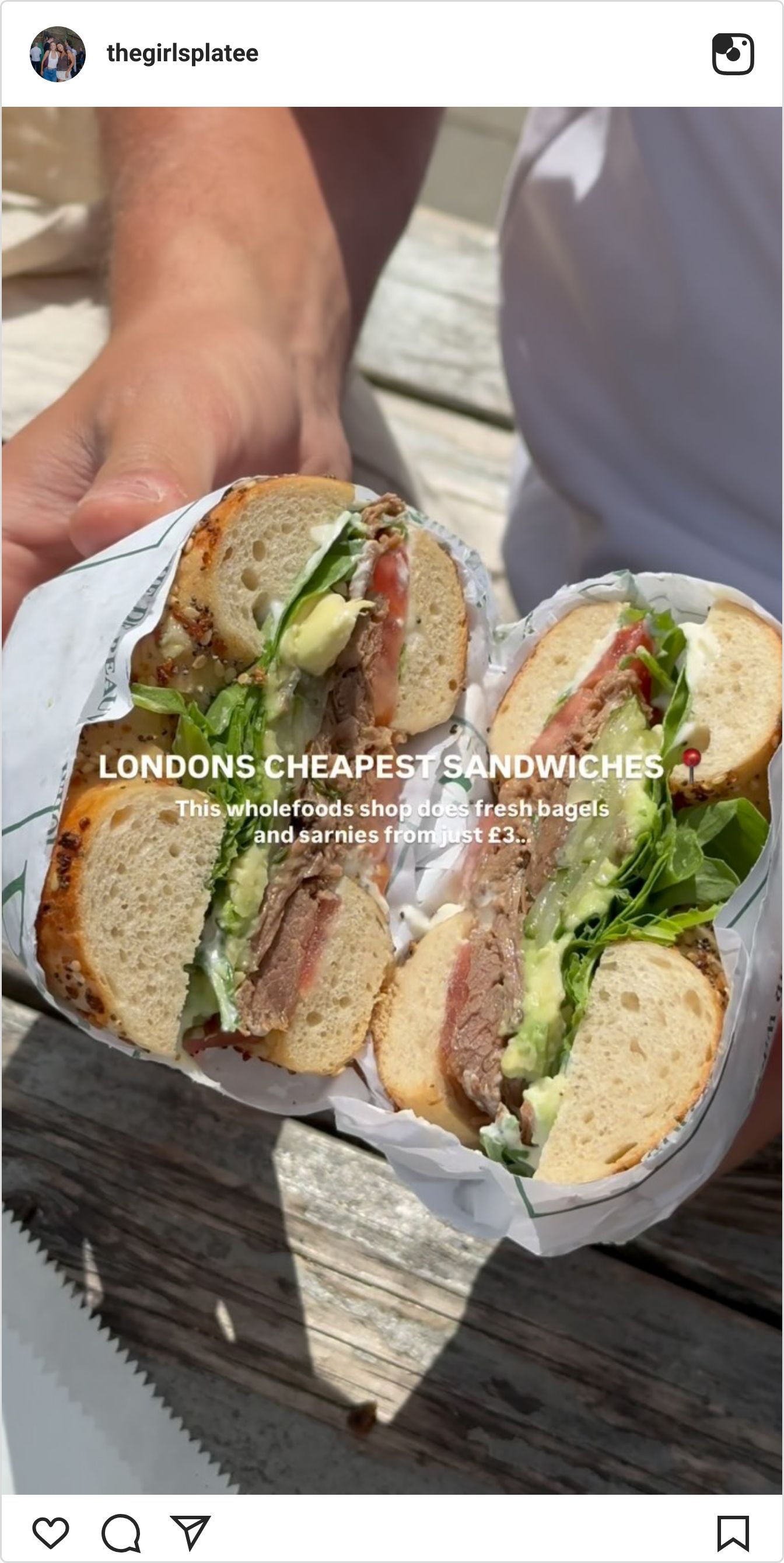
Their egg bagel is just the perfect egg bagel. The bagels are topped with sesame seeds, poppy seeds and tiny crispy bits of onion, and the egg mayo itself is perfectly creamy and dolloped in so generously that I've had to invent a special technique to eat it mess-free: gently squeeze it and lick around the edges until you can bite into it sans ooze. They also do cream cheese ones for £3, but as the fillings and breads get fancier, you're talking upwards of £8. The turkey with black olive tapenade and stracciatella cheese focaccia is also excellent, but at around £11, I don't get it often.
5. What would your perfect no-spend London day entail?
Earlier this year, I took two months off work to clear my head and recover from a particularly nasty bout of burnout, so I ended up with quite a few no-spend London days to research my answer to this question (everyone say, 'thank you, Em's burnout!').
My routine went something like this: wake up at 8:30, stay in bed reading until 10, force myself up at 10:05. Shower and – if I feel extra sad – wash my hair. Put on a fun outfit to force some dopamine into my brain. Leave the flat and walk in whichever direction I didn't walk in yesterday, on a 'Queen of Different Ways Walk' (I'll explain this in a second). Pop into a pub with my book for a pint of lime and soda. Watch the people go by. Head home. Turn on Absolute Radio for company. Sit in the garden and worry about the current status of the cherry tree (it blossomed too early this year). Hang out with my husband. Cook something together, eat something together, watch something together. Think about maybe writing something. Remember I'm supposed to be resting. Make a note to write about it later. Pick up my book. Take it to bed. Sleep for nine hours. Repeat.
This routine definitely helped me get better – and the 'Queen of Different Ways' walk was crucial to that. The name comes from when I was little, and my dad called me 'The Queen of Different Ways' because a) I always had to do things my own way, and b) every time we'd drive up to my gran's house in Maesteg, South Wales, I'd ask if we could go 'a different way' – which was really only one of three options, so we'd just take whichever route we hadn't taken last time. It was enough to keep me entertained, and it became my thing.
Now I apply this ethos to a daily walk: leaving the flat with no aim other than to return a few hours later, having gone a different way. Sometimes it means going down a new street, exploring a new corner, or just taking a new route. Sometimes it involves walking by the canal, or people-watching at London Fields, or smiling at the conversations I overhear outside The De Beauvoir Arms. There are endless combinations – every day brings such novelty, and I feel like I'm really getting to know my neighbourhood.
Over the years, I confused 'a good day' for 'a busy day'. I don't do that anymore. If burnout has taught me anything, it's that our compulsive need for 'more' can actually be solved by accepting 'less'. In many cases, chasing more work, more money and more success leads to less time, less quality of life and less happiness. In trying to do a lot less, I really have found so much more. You can girlboss your way to the sun if you want – but the sun is hot, and it will try its best to burn you.
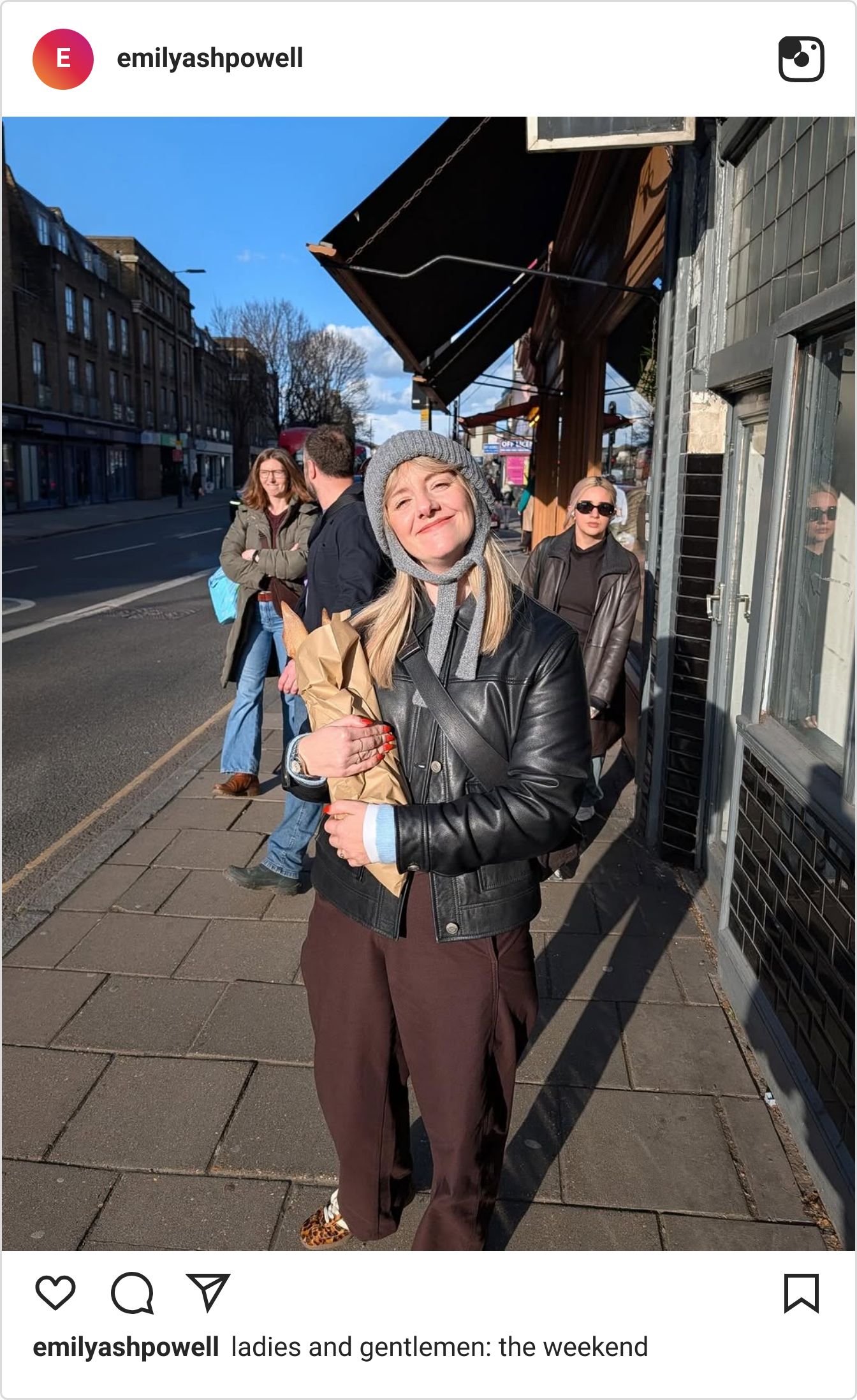
6. As a writer and brand consultant, where's your favourite London place to get your creative juices flowing?
When my creative juices are in flow state, I have to be at home, at my desk. They tend to only start flowing before 8am or after 8pm, which is exceptionally unhelpful when a workday runs 9–5 (or 9–9, if you work in startups). But that's the great thing about being freelance.
So much of good writing is good thinking, and good thinking comes from being interested in and paying attention to the world around you. And writing isn't always done at a desk – more often than not, the seeds of ideas form when I'm out and about: walking along Regent's Canal, cycling down Upper Street or swimming at London Fields Lido. As they float into my head, I squirrel them away in my Notes app and bring them home to craft later.
I also read a lot, and in a lot of different places – on the bus, at cafés, in pubs, on park benches, by the canal, in the garden, in bed. There are some really excellent pubs around De Beauvoir to sit and read in, and the conversations you overhear are often rich in inspiration. The Rosemary Branch is one of the less pretentious ones, as is The Fox.
7. What's the latest hidden London gem you've discovered?
Leigh's coffee shop at One and a Half, Ardleigh Road. I spotted Sharon Horgan (my writing idol) standing outside a few weeks ago. They do great toasties and tolerate my new, difficult coffee order – an oat flat white with one shot replaced with decaf (a half caff, apparently, and the maximum amount of coffee I can cope with without having an anxiety attack).
8. As a newsletter person, are there any London newsletters you'd recommend? (Except Cheapskate, of course!)
Cheapskate is obviously number one. But I also love The Londonist: Things To Do, Islington Local Guide, Hackney Beat and Hannah Louise's Good Time Girl – which isn't London-specific but is often London-centric.
9. If you were Mayor of London, what's the first thing you'd change about the city?
Switch the ugly new electric 141 buses back to the Routemasters. Immediately. The new ones are so ugly, so cramped and feel so cheap. Yes, they have USB ports – but at what cost! I hate them. Also, they're unreliable and constantly changing their destination. Please, just let me get where I need to be.
Also: better cycle lanes, play areas for foxes, a ban on FaceTiming without headphones on public transport, and a ban on anywhere charging more than £6 for a pint or a glass of wine. Thank you.
10. In three words, what makes someone a Londoner?
Although I've lived in London for a decade, I'm not sure that's earned me the right to call myself a Londoner. Plus, I wouldn't give up my Welsh identity for anyone or anything. My husband grew up in Ruislip, at the end of the Central line, but I wouldn't call him a Londoner either – especially since he recently pointed at Drury Lane and said, 'that's where the Great Fire of London started,' confusing it for the home of the Muffin Man.
But there's definitely a certain kind of person who sticks around in London after the initial novelty wears off, after the first wave of friends move out and bigger, cheaper properties start to look more appealing. And maybe that's what a Londoner is: someone who wasn't born here but creates a life here, calls it home and embeds themselves in their local community. Someone who accepts a smaller living space for a bigger life. Someone who decides that a higher cost of living is still worth it, for whatever opportunities they're chasing. Someone who is interested in different stories, backgrounds and cultures. Someone whose mind has been opened and horizons broadened by the city – and still has faith that it might do so further.
If that's what makes a Londoner, then my three words would be: resilient, interested, ambitious.
I think if the time comes where I don't tick all three of those boxes, I'll know it's time to go.
Subscribe to Emily’s newsletter here.